A Sun-Safe Beach Morning Routine: From Wake-Up to First Swim
The most common failure point in beach sun protection isn't the products — it's the timing. Most beach-day sun damage occurs in the first 30 minutes of beach time, before people have fully applied sunscreen, before the product has had time to bind (for chemical sunscreens), and before they've remembered the lip balm. The morning routine problem is a sequencing problem, not a product problem.
This guide builds a sun-safe beach morning routine that addresses the timing gap — so the first sun exposure of the day is protected sun exposure rather than the unprotected gap between arrival and "getting organized."
The Timing Problem | Step-by-Step Morning Routine | The Car Application Rule | What to Pack | Beach Arrival Sequence | Family Coordination | FAQ
The Timing Problem: Why the First 30 Minutes Are High-Risk
| Time Point | UV Exposure Risk | Typical Protection Status |
|---|---|---|
| 6–8 AM | Low-Moderate (UV index 2–4) | Most people are not yet protected |
| 8–10 AM | Moderate-High (UV index 4–7) | Typically arriving at beach — application happening |
| 10 AM–2 PM | Very High (UV index 7–11+) | Peak UV; requires full protection + early reapplication |
The critical gap: for chemical sunscreens, 15–20 minutes must elapse between application and effective protection. If sunscreen is applied at the beach, the first 15–20 minutes are unprotected. For beach arrivals at 10 AM — peak UV — this is a high-exposure window.
The Sun-Safe Beach Morning Routine: Step by Step
At Home — Before You Leave
- Shower and pat dry: clean skin absorbs sunscreen more effectively than skin with accumulated oils or prior product.
- Apply sunscreen as the last step before dressing: Panama Jack SPF 50 to all areas that will be exposed — arms, legs, shoulders, back of neck, ears. This is the full-body application; do not abbreviate it.
- Apply SPF 45 lip balm immediately after sunscreen: the lip step is the most commonly missed. Making it part of the sunscreen application step ensures it happens.
- Allow 15–20 minutes for chemical sunscreens to bind: the drive to the beach serves as the binding window.
- Apply sunscreen to face last: apply facial SPF after all other preparation is complete.
Apply sunscreen in the bathroom or bedroom — not at the beach. This solves the timing problem completely: the 15–20 minute binding window passes during the drive, and you arrive with active protection in place.
In the Car
- Final lip balm check: keeping Panama Jack SPF 45 in the car's center console means it's always accessible for this check.
- Set the first reapplication alarm: 90 minutes from the time sunscreen was applied at home — not from beach arrival.
- Apply to newly exposed areas: if you've changed into beach clothing during the drive, cover any newly exposed skin now.
Beach Arrival: The Drop Sequence
- Establish your spot — umbrella, chair, cooler placement.
- Apply sunscreen to any areas missed during the home application.
- Apply SPF 45 lip balm again — the home application was 30–60 minutes ago. Reapply now as the starting clock for the beach day.
- Hats and UPF clothing on before walking to the waterline.
- Start the 90-minute timer for the first full-body reapplication.
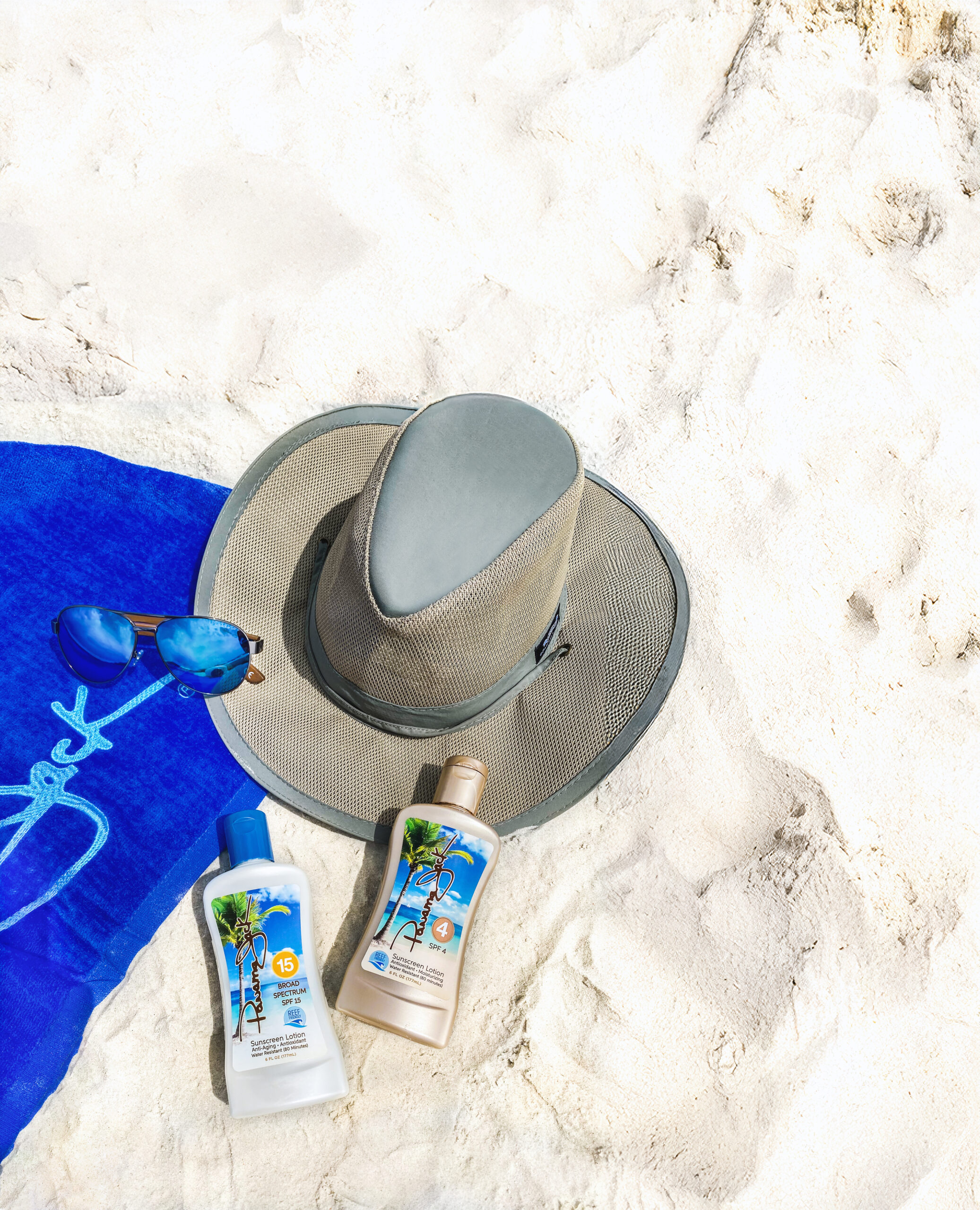
Panama Jack SPF 50 Lotion + SPF 45 Lip Balm + Panama Jack Hat — the three-part beach drop system. All available on Amazon.
What to Pack: The Complete Beach Sun Protection Kit
| Product | What It Does | When to Use |
|---|---|---|
| Panama Jack SPF 50 Lotion | Full-body initial application | At home; reapply every 90 min |
| Panama Jack Continuous Spray SPF 30 | Easy reapplication for body | 90 min intervals; after swimming |
| Panama Jack SPF 45 Lip Balm | Lip protection | Every 2 hours; after eating/drinking/swimming |
| Wide-brim hat or boonie hat | Mechanical UV shade | Wear throughout beach day |
| Panama Jack Aloe Vera Gel | After-sun recovery | After last outdoor activity of the day |
Family Beach Morning Coordination
- Apply sunscreen to children first, at home, before the adults begin their own routine. Children's 15–20 minute binding window runs while adults complete their routine.
- Assign roles: one adult does children's sunscreen; other adult organizes beach bags. Sunscreen application and packing happen in parallel.
- Children's lip balm: Panama Jack SPF 45 in Tropical or Mango flavor is the compliance choice for kids. Apply immediately after sunscreen — same step, same routine.
Frequently Asked Questions
When should I apply sunscreen on a beach day?
At home, 15–20 minutes before UV exposure — not at the beach. This solves the binding window problem and ensures you arrive with active protection in place. Apply to all areas that will be exposed, including lips, ears, and the back of the neck.
How often should you reapply sunscreen at the beach?
Every 80–90 minutes during beach activity, and immediately after every swim or heavy sweating. Water removes the sunscreen film; the reapplication clock resets to zero every time you exit the water.
Is it safe to apply sunscreen to children at home before the beach?
Yes — applying sunscreen to children at home rather than at the beach is the correct approach. It ensures the 15–20 minute binding window passes before UV exposure. Reapply at the beach arrival sequence and then every 60 minutes.
- A Complete Family Sun Protection Strategy for the Whole Summer
- Best Outdoor Summer Activities for Kids — With Sun Safety Built In
- Best After-Sun Lotion: Recovery Products That Help Skin Heal Faster